
CSOs, university help with pandemic recovery
Resilient Communities
Nature based Solutions (NbS)
Climate resilience
Food preservation
Disaster Risk Reduction
Gender & Social Inclusion
Empowered communities
Resilient Communities
Nature based Solutions (NbS)
Climate resilience
Food preservation
Disaster Risk Reduction
Gender & Social Inclusion
Empowered communities
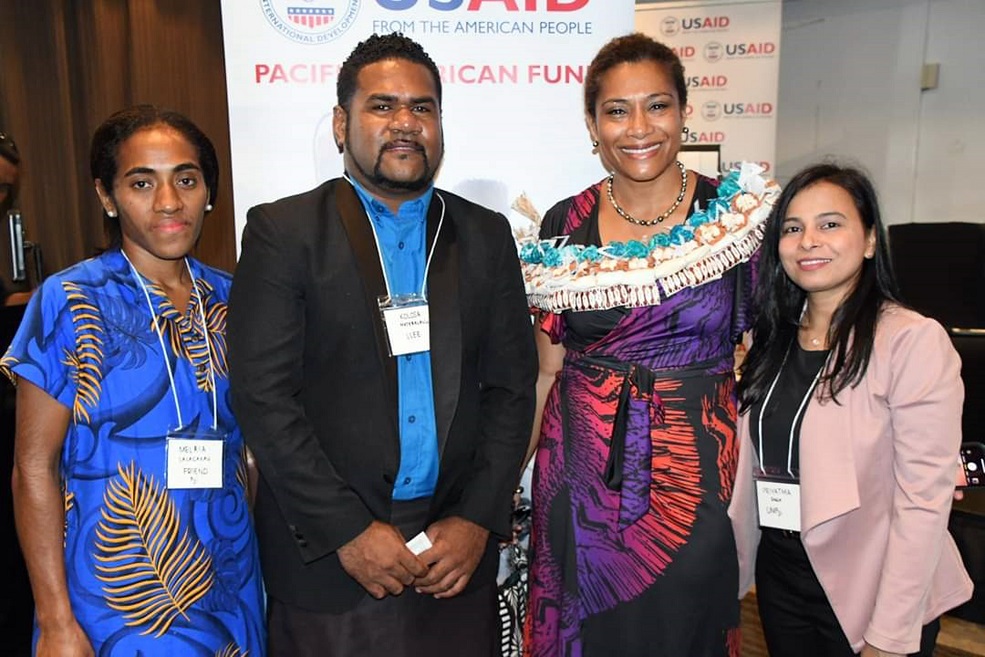
Three Fijian organisations were able to assist thousands of Fijians sustainably navigate the economic challenges of the COVID-19 pandemic through funding provided by USAID.
The three were the Foundation for Rural Integrated Enterprise and Development (FRIEND), University of Fiji, and Live and Learn Environment Education Fiji.
FRIEND project manager Melaia Salacakau said with the funding, they were able to increase skills for 2300 Fijians through seven livelihood training programs.
“So the different livelihood schemes training (and) intervention that we put together was soap-making training, oil efficient training, food processing activity, food production, compliance training, seafood processing training and sea salt training,” she said.
She said they targeted areas such as Sigatoka, Nadi, Lautoka and the Yasawa Group as they were heavily reliant on the tourism industry.
Ms Salacakau said during the COVID-19 pandemic, the livelihood training greatly assisted people in terms of earning an income and eventually supporting themselves.
“Some of them have been have been selling overseas to family and friends as well as in their community.
“As for the sustainability of the project, FRIEND is putting together an e-commerce platform where all the beneficiaries will be able to sell and market their products globally.”
The University of Fiji, the only grant recipient outside of the NGO and CSO space, worked with two communities in reviving their aquaculture farms for tilapia farming.
Lecturer Priyatma Singh said they noted that during the peak of the pandemic, food security became a concern. They had a non-functioning pond which the university decided to revive through the American Pacific Grant.
“So it’s not just this training centrally, of course, we helped them to upgrade their skills but they also with resources and some very important equipment that was needed for them to sustain the pond,” Singh said.
“So we provided them with the training in a pond preparation activities. We also provided training with the feeding, with harvesting, financial literacy, provided them with the trainings marketing as well.
“One of the other things we have done is incorporated the outcomes of the project into our Environmental Science course at the university.”
Live and Learn Environment Education Fiji project manager Kolosa Matebalavu said they received the grant under the disaster risk management area.
He said through their community programs they realised that the one-size-fits-all approach did not work as it never addressed the needs of everyone in the community.
“When we’re talking about communities that have different groups of people that live in our communities, they have different needs, they have different capacities, they have different strengths and most of the time when we take a one-size-fits-all approach, that’s how people get mixed up, don’t respond to their needs,” he said.
The USAID grants have a duration of 12 to 20 months and are divided into two categories; the small NGOs and CSOs eligible for a funding of up to $US150,000 ($F327,000), while the more experienced NGOs are eligible for a grant ranging from $US300,000 ($F654,000) to $1 million ($F2.18m).
The grant started in August 2020 as USAID assisted Pacific Island countries in their fight against the impacts of Covid-19.
USAID, through various means, has provided Fiji with up to $122 million worth of assistance to combat the negative impacts of the pandemic.
Source: Fiji Times
Date: 10/02/2023